
The oil filter is one of a car engine’s most unassuming components, yet its role is absolutely central to the long-term durability of your vehicle. While many drivers focus on which brand of oil they use, few realize that even the best oil on the market loses much of its effectiveness if it passes through a poor-quality filter. In this article, we’ll explore how a filter influences engine mechanics over thousands of kilometres, and why this small metal cylinder deserves far more attention than it typically receives. Understanding how it works also helps you make better maintenance decisions and avoid costly repairs caused by simple neglect.
What Happens Inside a Running Engine
To understand the importance of the oil filter, you first need to visualize what happens inside a running engine. Hundreds of metal parts slide, rotate, and collide thousands of times per minute. Every friction event produces microscopic metal particles that mix into the oil. Add to that the soot from combustion, unburned fuel residue, and dust that manages to get past the air filter. Without an effective filtration system, this abrasive soup would circulate continuously through the oil passages, scratching bearings, wearing journals, and damaging the camshaft. This accelerated wear can cut the engine’s useful life in half.
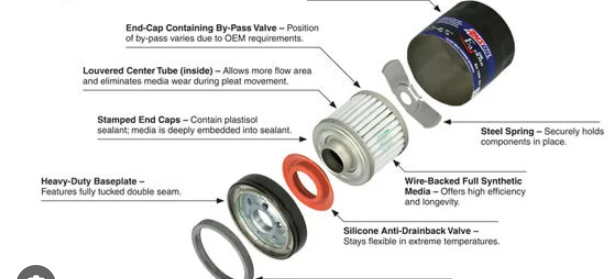
A quality oil filter captures these particles through a filter media engineered to retain elements just a few microns in size. The difference between a basic filter and a premium one usually comes down to three key criteria: retention capacity, developed filter surface area, and the media’s resistance to high temperatures. A poor-quality media can tear under pressure or clog prematurely, triggering the bypass valve to open. At that point, unfiltered oil returns directly into the engine, carrying all its contaminants with it — and the filter is no longer doing its job.
Why Replacement Frequency Is Crucial
How often you change your filter also plays a crucial role in your engine’s mechanical health. Some owners make the mistake of replacing their oil without touching the filter, thinking they’re saving a few dollars. It’s a false economy that can prove very expensive. A saturated filter stops working, no matter how clean your new oil is. Manufacturers generally recommend changing the filter with every oil change, and for good reason: the filter fibres degrade over time, even if the filter hasn’t reached full saturation. Repeated exposure to high temperatures progressively deteriorates the media structure.
Cartridge vs Spin-On Filters
There are several types of filters on the market, and they are not all equal. Cartridge filters, commonly found on modern engines, allow only the filter media to be replaced without discarding the entire metal housing. This approach is more environmentally friendly and often more cost-effective over time. Traditional spin-on filters, more common on older engines, integrate all components into a disposable housing. They offer the advantage of very quick installation. Each type has its merits, but in both cases, the quality of the filter media remains the number one criterion when making a purchase.
The Anti-Drain-Back Valve
Another often-overlooked element is the anti-drain-back valve. This small component prevents oil from draining back into the sump when the engine is off. Without it, your engine would run for several seconds without adequate lubrication at startup, multiplying wear over the years. Budget filters sometimes have a low-quality valve that seeps gradually, causing premature wear that most drivers mistakenly attribute to other factors. This is why it’s better to invest in a product from a recognized manufacturer rather than save a few dollars on such a critical component.
Resistance to Extreme Temperatures
Operating temperature is also a decisive factor in overall performance. A quality filter must be able to withstand significant temperature spikes without losing effectiveness. Tests under extreme conditions show that some entry-level filters see their performance drop sharply beyond a certain temperature — exactly when your engine needs them most. In hot climates or during extended high-speed driving, this difference becomes particularly critical. A good filter maintains its performance across the full temperature range experienced by the engine.
Price vs Quality: The Real Calculation
Price doesn’t always equal quality, but quality always has a price. A premium filter typically costs between $15 and $35, compared to $5 to $10 for an entry-level model. Over an engine lifetime of 200,000 kilometres, this represents a total extra cost of just a few dozen dollars — compared to an engine replacement that can easily exceed several thousand dollars. The choice is obvious. Premium filters also often offer superior retention capacity, sometimes allowing you to extend service intervals without risk.
The filter’s dimensions must also precisely match the engine’s specifications. A filter that is too short or too long can cause leaks or poor oil circulation. The exact dimensions, centre thread pitch, gasket diameter, and volumetric capacity must all match the manufacturer’s requirements. Many websites now offer search tools by vehicle make and model that make this verification much simpler and help beginners avoid common purchasing mistakes.
In summary, saving a few dollars on an oil filter can cost a great deal more in the long run. Repairs to an engine damaged by inadequate lubrication far exceed the cost of years of premium filters. Taking the time to choose a filter suited to your engine, respecting replacement intervals, and favouring recognized manufacturers are three habits that can easily double your vehicle’s useful life. At superfilter.top, we believe a good filter is not an expense — it’s a genuine investment in your engine’s mechanical health and in your everyday peace of mind as a driver.
Looking for the right filter for your vehicle?
SuperFilter.top lists over 10,000 cross-references — all major brands, completely free.